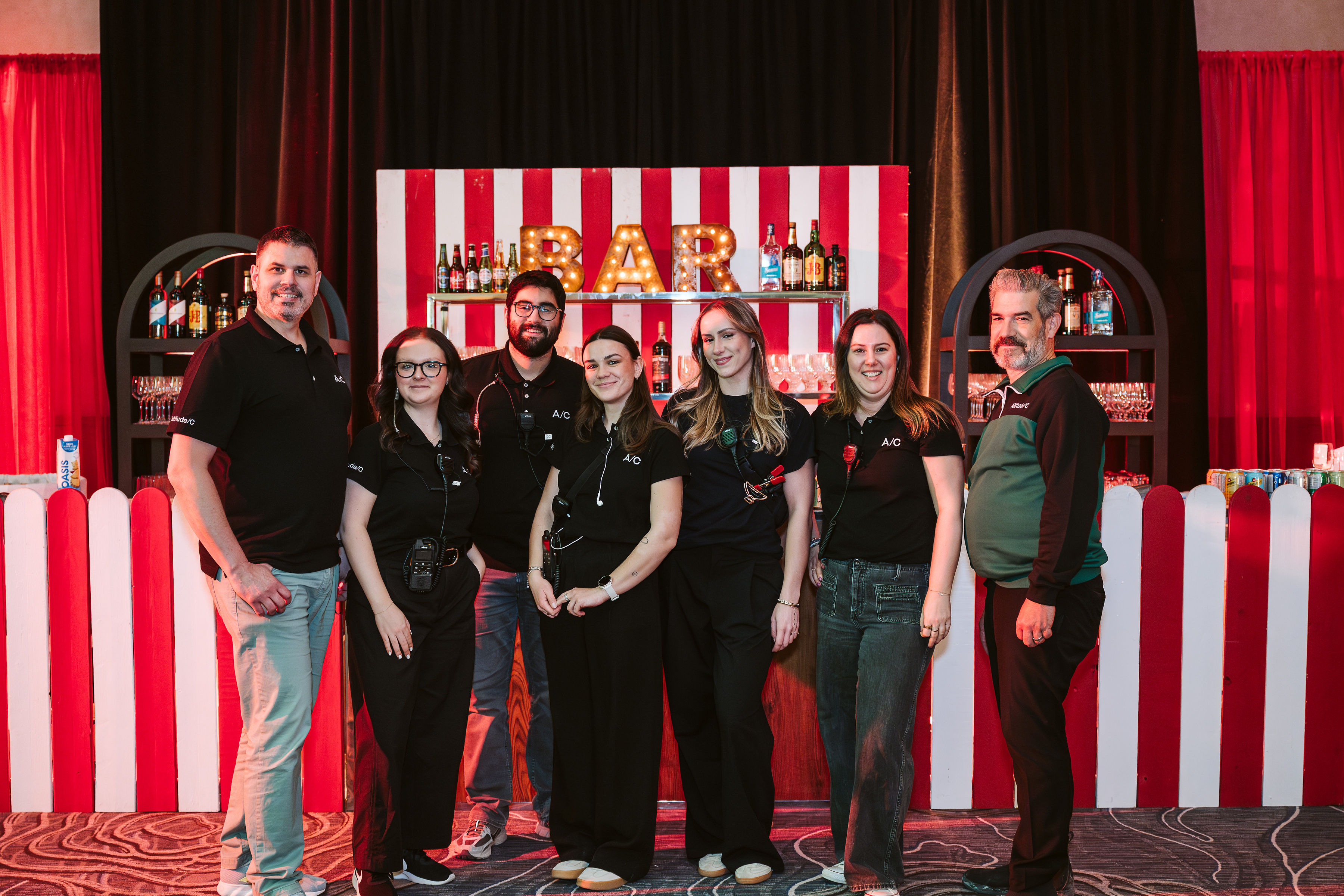

Let's turn to what awaits us in 2026: what will be the new standards in the event industry? What should we expect when organizing an event in 2026? One thing is certain: the bar is being raised, both technologically and humanly. Here are 5 trends that we think are defining this new year in intelligent and human event design.
Hybrid events
The hybrid event is now a basic expectation. By combining the energy of the face-to-face and the accessibility of the virtual, we open the doors to a larger audience during an event. On the financial side, it also makes it possible to save on accommodation and transport costs or to simply allow people who cannot show up on the premises to have access to the event.
The challenge is to offer an experience of equal quality, both virtual and face-to-face. Content must be adapted from the face-to-face format to the digital format. In 2026, tools allow for a more immersive experience and platforms are increasingly interactive, which greatly favors the design of hybrid events.
Immersion, a driver of emotion
No more frozen events. Make way for multisensory immersion. Thanks to virtual reality, 360° projection or dynamic scenography, brands immerse participants in powerful narrative worlds where every detail counts. This approach is already at work in events such as Effervescence, where scientific content comes to life in scenographic environments that evolve over the course of the program, or at the MTL Climate Summit, where the use of space, lighting and interactive devices amplifies the sense of climate emergency.
Immersion then becomes a strategic tool: it promotes memory, reinforces alignment around a common vision, and opens the door to deeper conversations between participants. When used properly, it allows brands to combine innovation, emotional impact and responsibility, by designing experiences that are both striking, sustainable and eco-responsible.
Artificial intelligence as a strategic support
In 2026, AI is not just a gimmick: it is a tool in every aspect of our lives. From the personalized recommendation of content for participants to the optimization of the user journey on platforms, it allows the experience to be refined without replacing it. Concretely, AI can analyze profiles, interests and behaviors in real time to suggest targeted conferences, workshops or meetings, adapt notifications, streamline orientation on site and online or even adjust the digital scenography according to the key moments of the day. It does not replace our event strategies, it improves our proactivity and our organizational efficiency.
AI also supports the teams behind the scenes: managing registrations, forecasting flows, optimizing transport and catering, measuring the environmental footprint. By combining this data, organizers can make better decisions, more quickly, and drive the experience with finesse rather than instinct. Using AI to guide our decisions will be a major change in the event industry in 2026.
Gamification and active participation
What is gamification? It's when an event uses game mechanics to eliminate the border between spectators and actors. In 2026, successful events are those that stimulate curiosity and participation. The participants are then more active and participate directly in the event, instead of sitting and listening to a conference. Live quizzes, interactive votes, collaborative challenges, personalized paths: participants want to play a role and feel that the event brings them new knowledge.
This dynamic reinforces commitment and creates a lasting collective memory. It promotes team-building as well as networking and makes it possible to bring in new ideas. Creating real networking activities, such as round tables or one-on-one meetings organized in a more fun format, changes the dynamics of traditional networking activities, such as the simple cocktail moment. Participants feel that they have truly had a significant experience, rather than just attending a program.
Eco-responsibility, non-negotiable
Addressing the climate crisis is a global requirement. To respond to this, events must, more than ever, take into account their environmental impact. The use of reusable materials, local caterers, travel limitations, carpooling platforms, reusable containers: every detail counts and must be checked carefully. If you want an event to have measurable results, a significant long-term impact and to be repeated from year to year, you must ensure that it is eco-responsible and that it does not have a harmful impact on the environment. It is also a question of coherence, an event that talks about innovation, leadership or a vision of the future cannot ignore its environmental impact. Organizations that respect the environment build more credible and meaningful experiences for the communities they bring together.
Towards smarter, more human events
What stands out from these trends is a desire to reconcile innovation and efficiency, technology and participation. The events of 2026 are hybrid but never impersonal. Immersive, but rooted in local realities. Connected, but deeply human. For brands and organizers, the challenge is clear: it is necessary to create experiences that are meaningful for communities as well as a responsible and sustainable environmental impact.


